

REWATCH: Atlanta United wows in preseason with...[checking]...basic tactical competency
Ok but seriously they did effective soccer things
via Atlanta United
This is our first rewatch column of 2026. This one is free. The next one (and nearly every one after that) will not be. If you’re not a paid subscriber and you enjoyed this one, consider joining us for $7 a month. If you are a paid subscriber and you enjoyed this, consider sending it to a friend who has $7 a month they’d like to spend.
It didn’t take much. Atlanta United, in one preseason game, already look like a better soccer team.
You can see it for yourself here.
Look, I’m not trying to read too much into a 4-0 scoreline against Lexington SC. Even if something close to Atlanta’s preferred starting XI hadn’t put up four goals in a half, I would have felt better about 2026 than 2025. The bar, of course, is incredibly low, but there have been relatively few changes to a team that nearly won the Wooden Spoon last year. It’s fair to be worried about a repeat performance. However, after just a brief glimpse (and reminder) of what a Tata Martino team looks like, there are tactical reasons to believe the floor is higher this season.
Real quick, let’s talk phases of play. I think that so many of us get conditioned to think about the sport as “Style + Base Formation = Tactics.” People get told a team plays in a 4-3-3 and they pass the ball a lot, or people go on EAFC and set up in a 4-2-3-1 and your players pretty much stay in that exact setup up and down the pitch. Basically, people get caught up on what the lineup graphic tells them.
There’s truth there, especially when it comes to personnel. But it doesn’t really explain how teams actually operate as the ball moves from team to team and gets closer or further away from goal. So when we say, “Tata Martino likes his teams to play in a 4-3-3,” that only gives us a small part of the story.
What we’re going to do today is look at little more of the story—at least from this one preseason game—and we’re going to do that by looking at three different phases when Atlanta has the ball. Different places use different terminology and definitions, but we’re going to with…
Buildup: How a team operates in the deepest areas of possession. Think goal kicks that are played short and defenders passing in front and inside their own 18-yard box.
Possession: This is more in the middle third of the pitch. As the team starts to progress the ball, the players take up new positions on the pitch and work to break into the final third.
Attack: The team has advanced all the way up the pitch and the majority of the team is operating in the final third and attempting to enter the penalty area.
If that doesn’t make sense now, hopefully it clicks as we go along. Starting with…
Buildup
If I’m going to distinguish what’s different about Martino’s setup, then we have to start with what Ronny Deila attempted last season. Please note, I said “attempted.” There seemed to be an initial tactical plan, it didn’t really work, tweaks were made, and, largely, it all turned into a big amorphous blob of nothing by the end as everyone took an early vacation.
But if we go alllllll the way back to Atlanta’s opening day win over CF Montréal last year, we can see a pretty clear picture of what Deila wanted buildup to look like. That generally held true throughout the season.

We’ll call it a 2-4-1-3. You might remember this ended up resulting in a lot of touches for Brooks Lennon in particular. You can see the space the fullbacks have, so you understand why.
We don’t have any overhead shots from preseason, but I attended the match and rewatched the stream. Here’s what Atlanta looked like in buildup on Friday. See if you can spot the differences.
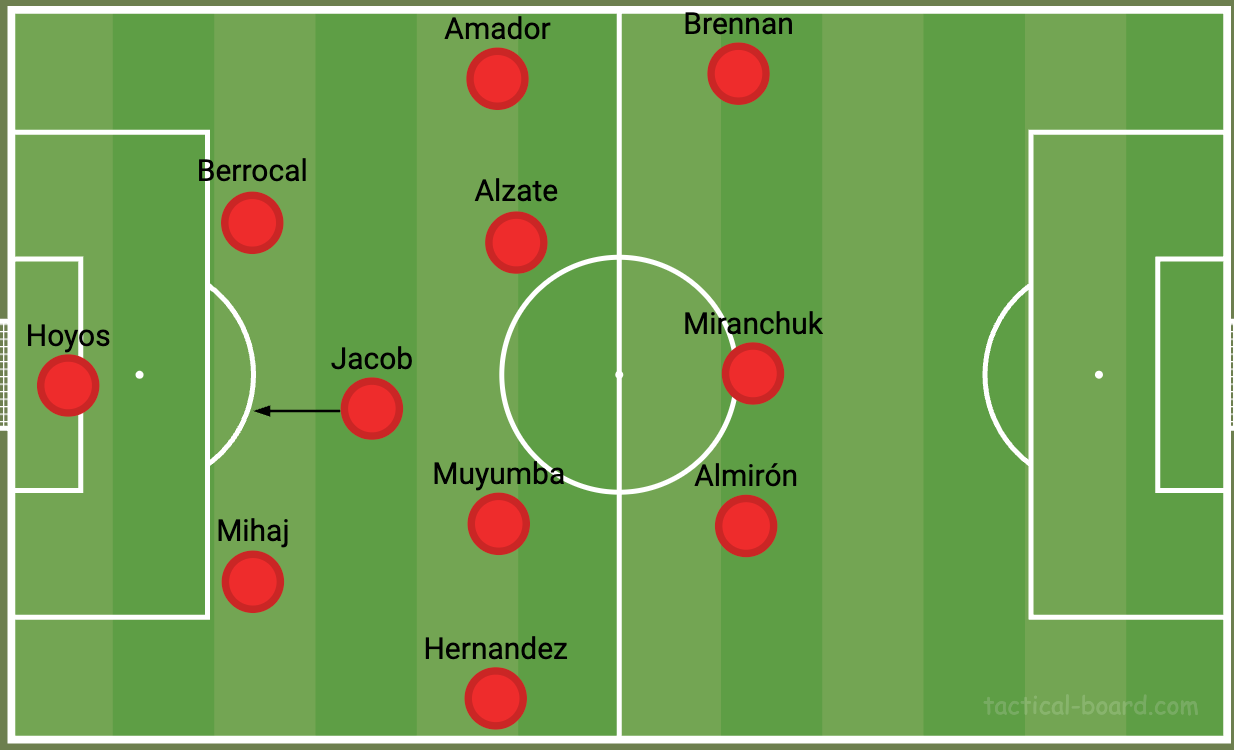
The big note here is that new U22 signing, Tomás Jacob is playing as the No. 6 here. In this version of Tata’s setup, the No. 6 is tasked with recognizing when they should stay in midfield or drop deeper into a line of three with the centerbacks. Typically, the No. 6 will join the center backs more often than not. You essentially end up in a 3-4-3 shape the majority of the time.
That’s not inherently better or worse than Deila’s shape, but you can see how it might offer a chance for more consistent numbers advantages closer to goal. Seven players in the first two lines are more than six. When you’re being asked to keep the ball on the ground and be brave on the ball as you build from the back, that one extra person can make a notable difference.
Possession
This is where Martino started to put a few wrinkles in. It’s also where things start to look more…well…”modern.”
I’m not a tactical savant by any means, but I do know that pretty much every great team in the world tends to up in something close to a 3-2-5 shape in possession. Deila’s Atlanta…well, they kind of just didn’t do this. Like at all. To be at least a little fair, I think part of that stemmed from not knowing what to do with both Alexey Miranchuk and Miguel Almirón. But still, it never seemed ideal that they never seemed to change the shape much, if at all, through each phase.
Remember that 2-4-1-3 in buildup against Montréal. Well, here’s Atlanta a couple of months later in possession against Inter Miami.
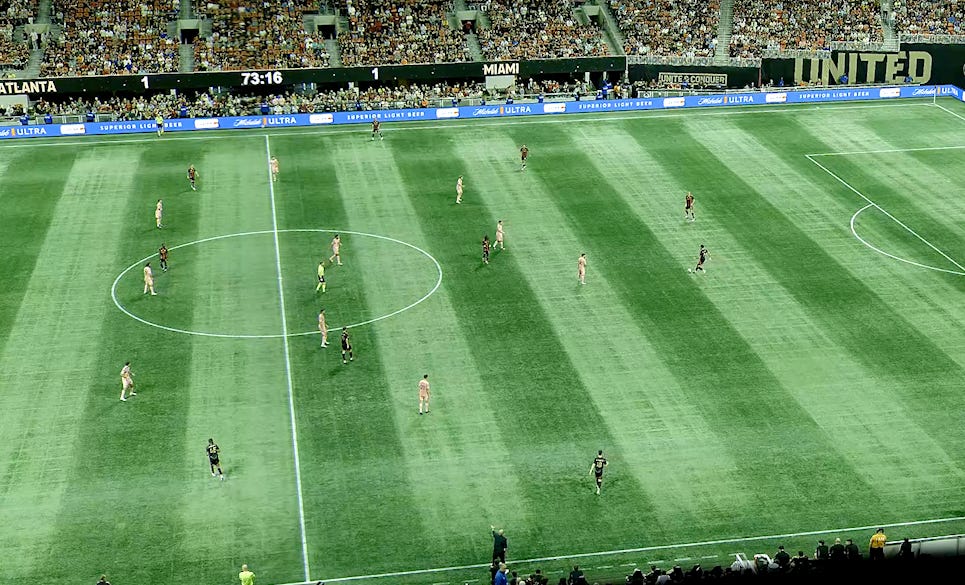
We’re virtually looking at the same picture here, just slightly higher up the pitch. I’m going to guess that ambling slowly up the pitch in the same shape with minimal rotations didn’t put too many defenders in conflict.
Now, here’s how Martino approached the possession phase in the first match of preseason against a USL-C side.
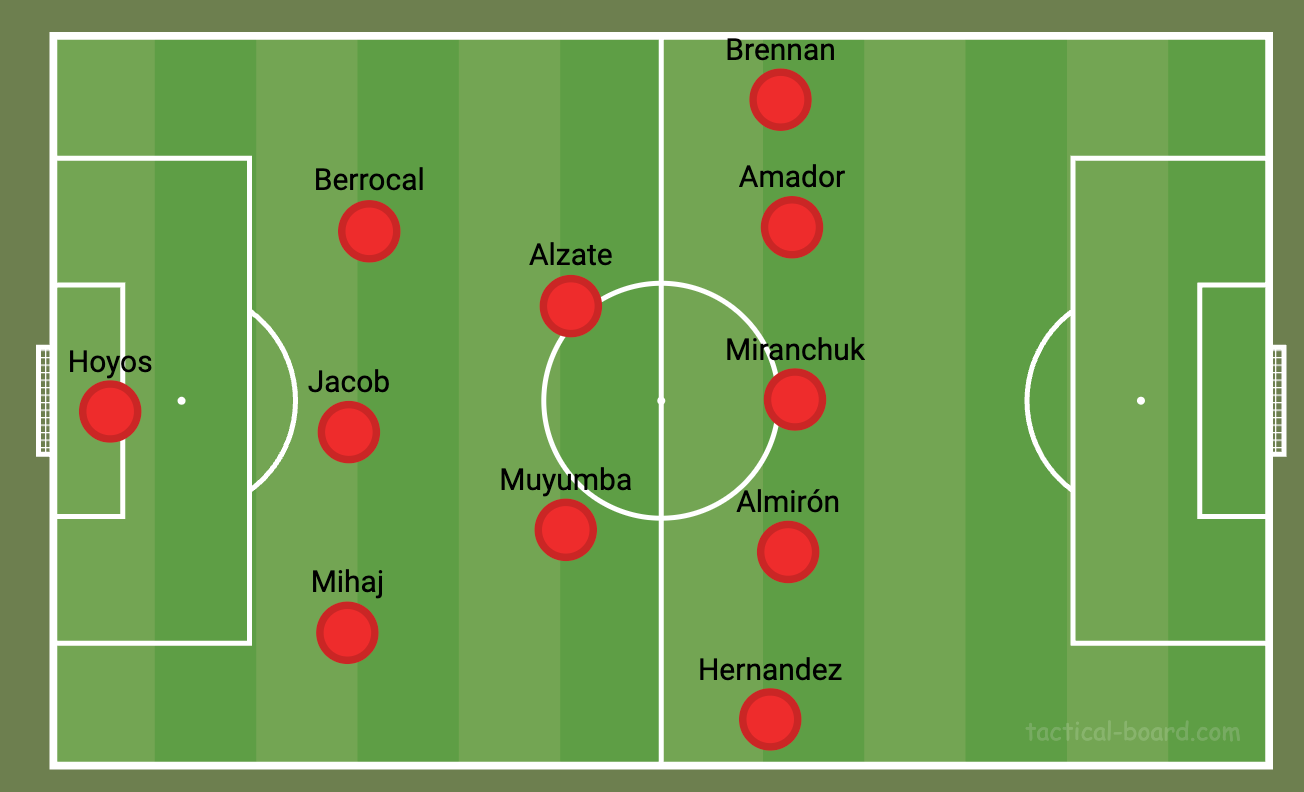
Again, we’re playing spot the difference here.
The main change is the positioning of the two fullbacks. Right back Ronald Hernandez pushes high up the pitch while Pedro Amador does the same, with a slight tweak. Amador underlaps Luke Brennan to create that line of five and give Lexington’s back line of four plenty to think about. I don’t think it’s a coincidence that two of Atlanta’s four goals came from Amador assists. Brennan added a pseudo-assist of his own when he drove into the box at speed and caught a lucky deflection into the path of Miranchuk.
Anyway, there’s a little more risk here. Atlanta’s fullbacks are advanced earlier and more often. It puts more pressure on the opponent’s back line AND more pressure on the five players in the first two lines to avoid critical mistakes. In the past, center backs like Michael Parkhurst have talked about living more “on an island” under Martino. Well, here’s the island. You’ve gone from six players (the “2-4” in the 2-4-1-3) to five.
Teams take that risk for a reason, though. If you can be brave and build effectively, then there are more opportunities to challenge the opponent’s back line. Against a typical four at the back setup, you’ll have a numbers advantage.
Alright, one more phase.
Attack
I didn’t save any shots of Atlanta in the attacking phase under Deila. I’m assuming that’s because the majority from the first half of the season would have just been stills of Brooks Lennon playing a cross. Maybe that changed later in the year when Lennon stopped starting, but, well, to be blunt, I stopped rewatching games intently when it became apparent the and Deila were cooked. So…like…May.
I feel like I can safely assume it looked something like this, though.
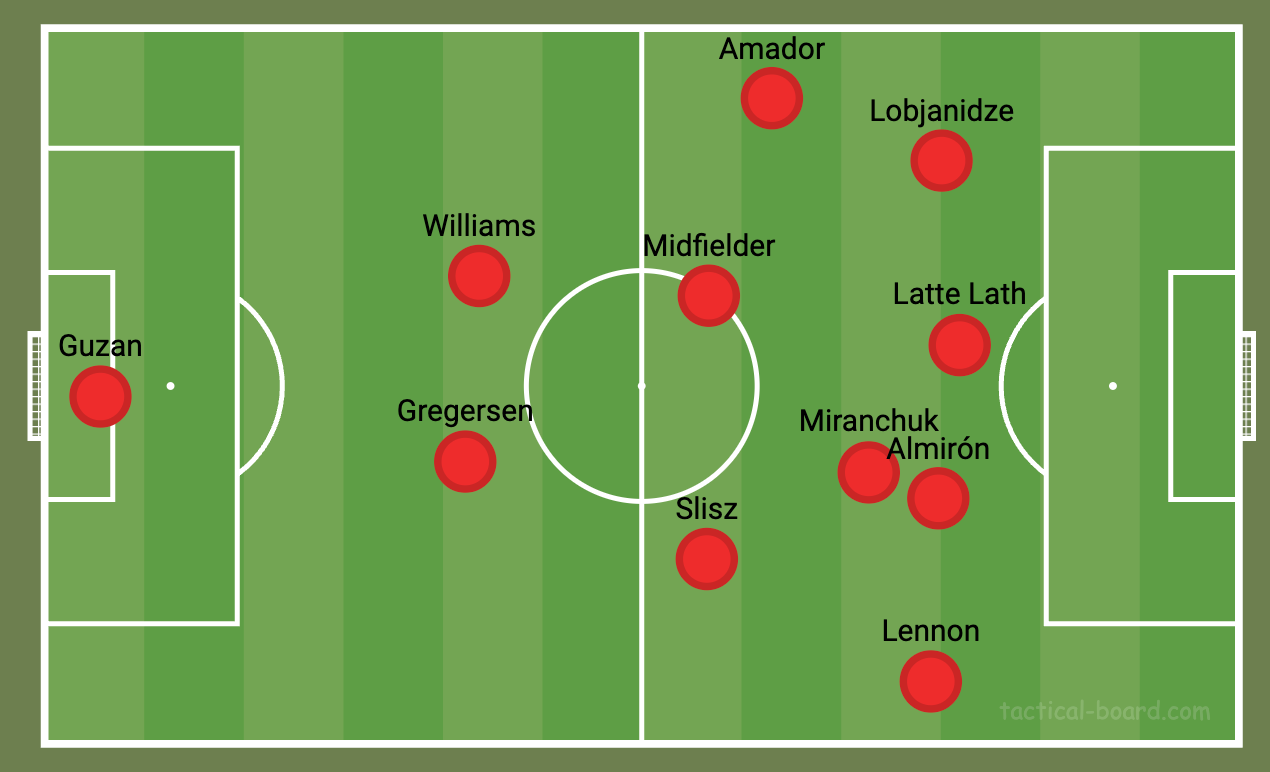
Basically, still in that 2-4-1-3 except Lennon is more advanced. Pretty much everyone has gone in a vertical line from buildup to attack. Again, I don’t think teams were stressing too much defensively here. Yeah, maybe at the start there would be some interesting rotations between Miranchuk and Almirón but that certainly didn’t continue. And it definitely didn’t force the opponent into many difficult decisions.
(Quick reminder. Here are the Eastern Conference teams who scored fewer goals last year: Toronto, Montréal, D.C. United, end of list.)
Ok, here’s Atlanta’s attacking shape on Friday.
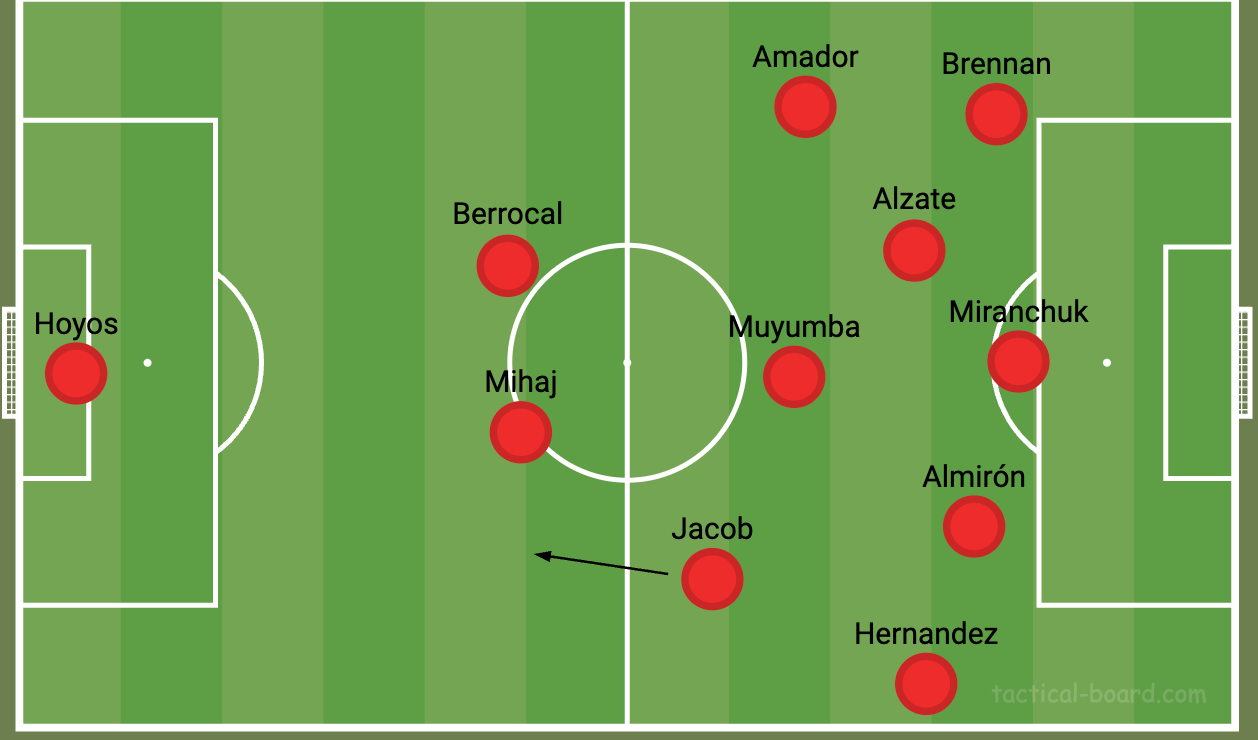
Our differences here start with Jacob. As Atlanta enters the attacking phase, he shifts out to the right and advances further up the pitch. He has the option to move back into the back line if he wants, but, typically, he stayed out here to the right as Atlanta moved into a 2-3-5 attacking shape.
It’s also notable that Amador usually dropped a bit into that middle line of three while Steven Alzate progressed toward the penalty area. Amador and Jacob give you a little more protection out wide as teams try to counter, and rotation of Amador and Alzate gives the back line a little more to think about.
In conclusion…
To be very, very clear here, none of this is groundbreaking. But Tata Martino’s tactics have already begun to look more modern and more effective than anything Deila trotted out last season. The players seemed assured of their roles and got into the spaces you’d expect a professional soccer team to get into in the 2020s. That’s a major improvement.
That doesn’t mean the team is saved. I still have a *lot* of questions that we’ll get to later this week. This roster is still…well, even if Martino’s more appropriate tactics raise the floor, the ceiling doesn’t feel high. Remember, “managers don’t matter” is shorthand for “managers don’t matter as much as the quality of a roster, however, a few managers can actively make a team worse and even fewer can truly elevate a team.” I don’t know if Martino falls into the “unicorn who can truly elevate a team via tactical innovation” category, but I’m certain he won’t actively make a team worse. And I’m certain Deila did.
There’s plenty more to talk about here. Mainly, the Miranchuk of it all. But we’ll deal with that tomorrow. Today, I’ll let everyone enjoy a little optimism.
I know hindsight is 20/20 and rose colored lenses and all, but I distinctly remember feeling discouraged during preseason 2025, and that's even knowing very well at the time that preseason is really unreflective of what actual season will look like. I also defended the bad look to doubters, making sure they knew that it would be different once we started playing regular games, but it still felt... off. And not to mention, I was wrong: preseason was absolutely reflective of how poor we would ultimately be.
2025 preseason never felt like anyone knew what to do or where their teammates were... or maybe even WHO their teammates were. 2026 preseason seemed to have direction, purpose, and early indicators of developing chemistry. Most of the first half players were familiar faces, so you would think they just had a headstart on chemistry, but you could watch any game toward the end of last year and you'd never know they had played together before (except maybe Miggy and Hernandez). And then the new faces we did intro with the rest seemed to slot right in and interplay well. Which I guess should be an expectation of professional players, but as noted, our floor is uh... low.
Anyway, one other observation is that Muyumba looked much less a liability than he did in 2025. I wonder if Tata just knows how to minimize the risk with tactics around him, which allow him to do his cutesy things (which when he does them well are really effective, but we just didn't see him do them well all year) without creating moments of danger when he makes a bad decision.